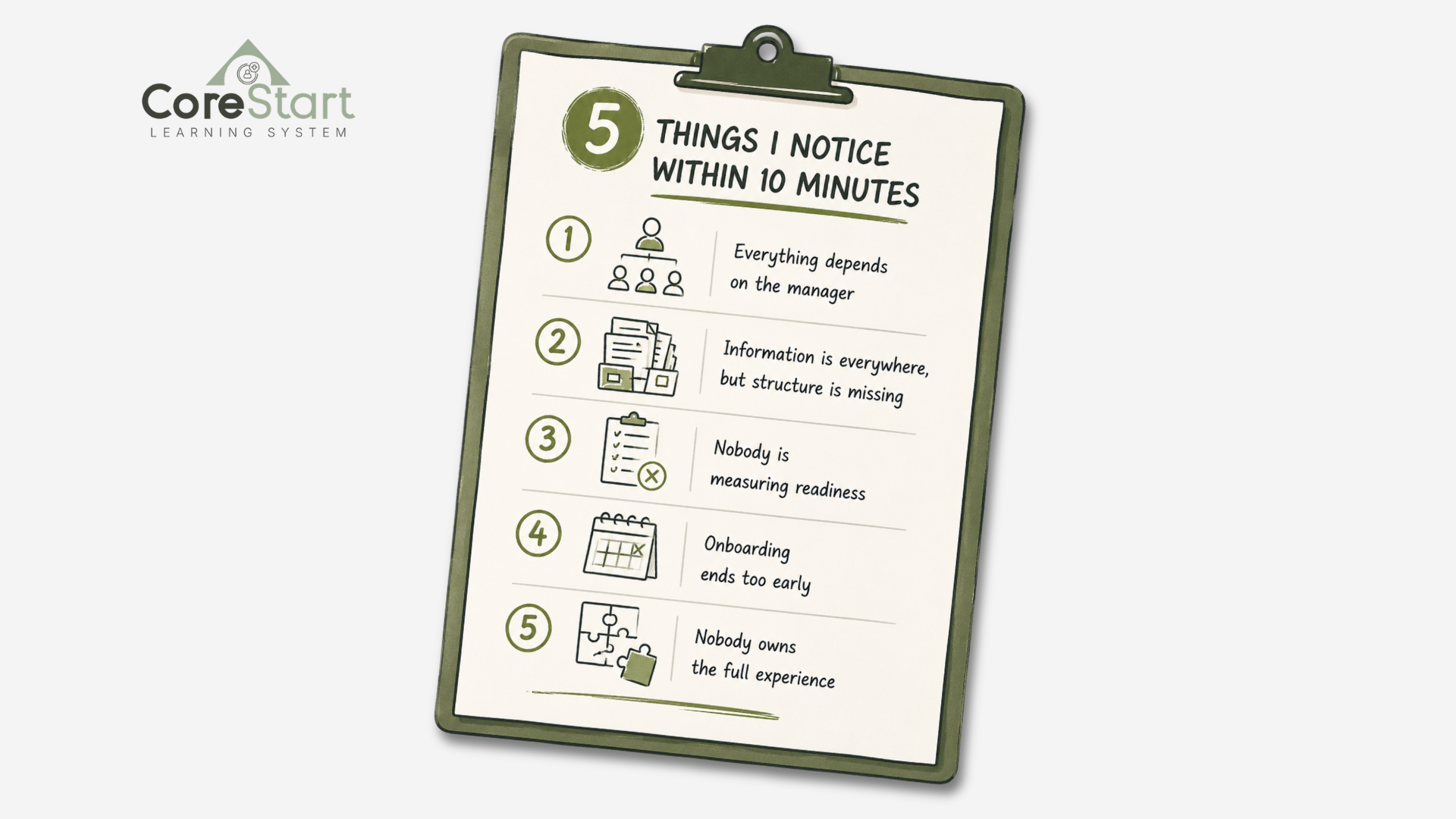
A great deal of onboarding problems are visible almost immediately. Not because the company is failing. Not because people don’t care. But because onboarding leaves noticeable clues. And, after reviewing enough onboarding processes, patterns start appearing very quickly. Usually I find these within the first 10 minutes of my review with small and medium sized businesses. Sometimes before I even finish looking through their materials.
See where your onboarding process may be creating confusion, inconsistency, or slower employee readiness. Take the Employee Onboarding System Audit
[Get Your Score →]
What’s interesting is that most companies don’t realize these things are happening because they’ve gotten used to working around them. The process “works” because employees eventually figure things out. But eventually figuring things out is very different from being intentionally supported toward proficiency. That gap is usually where I find that the real problems live.
The first thing I notice: everything depends on the manager
This is one of the biggest indicators that onboarding is unstable.
If onboarding only works when a specific manager is highly organized, highly available, or naturally good at coaching, then the process itself isn’t doing the heavy lifting. The manager is.
And that becomes a problem the moment the manager gets busy, or multiple people are hired at once, or priorities shift, or different locations handle onboarding differently, and if leadership changes. Strong onboarding should not rely on memory, personality, or good intentions.
It should create consistency even when things get busy.
The second thing I notice: information is everywhere, but structure is missing
Most companies actually have more onboarding material than they realize. Documents, videos, job shadowing, notes, SOPs, verbal instructions, Slack messages, and the list goes on. “Just ask if you need help.” The issue usually isn’t lack of information. It’s lack of structure.
New hires are often receiving information without understanding:
- what matters most first
- what success actually looks like
- how everything connects together
- what they are expected to independently own
- what they should focus on this week versus next month
When structure is missing, onboarding starts feeling reactive instead of developmental.
The third thing I notice: nobody is measuring readiness
This is where onboarding quietly breaks down. Most companies track completion. Very few track proficiency.
There’s usually no clear way to answer questions like:
- Is this employee becoming more independent?
- Where are they struggling?
- Which skills are improving?
- What still requires coaching?
- Are we actually reducing time-to-proficiency?
Instead, progress gets measured through general impressions:
- “We think they’re doing OK.”
- “They seem to be catching on.”
- “That person learns fast.”
But without clear checkpoints, onboarding becomes subjective. And subjective onboarding creates inconsistent outcomes.
The fourth thing I notice: onboarding ends too early
Many onboarding processes stop right after orientation or initial training. But employees are rarely fully confident or fully productive that early. This creates a dangerous gap.
The company assumes onboarding is finished. The employee is still trying to figure things out. That’s usually when mistakes increase, confidence drops, and managers begin feeling frustrated because they thought the employee “should already know this.” Efficient onboarding continues beyond the first week. Sometimes well beyond it. Especially for roles that require judgment, communication, and independent decision-making.
The fifth thing I notice: nobody owns the full experience
Different parts of onboarding often belong to different people. HR handles paperwork. Managers handle training. Coworkers answer questions. IT handles systems access. But nobody is overseeing the onboarding experience as a whole. That’s when things start slipping through the cracks, not intentionally, just operationally. And when onboarding ownership is scattered, the employee feels it immediately. They experience onboarding as disconnected instead of guided.
What strong onboarding usually looks like
The strongest onboarding systems I’ve seen are rarely the fanciest. They’re usually the clearest. They create:
- consistent expectations
- visible progress
- structured coaching
- clear priorities
- manageable learning progression
- accountability without overwhelm
Most importantly, they help new hires build confidence gradually instead of expecting immediate independence.
One important thing to understand
None of these issues mean a company is broken. In fact, many growing businesses experience them naturally because onboarding often evolves reactively over time. Hiring increases. Managers get stretched thin. Processes change. Training gets added little by little. Eventually onboarding becomes a collection of good intentions instead of a connected system.
That’s usually the point where companies begin noticing:
- slower ramp-up time
- inconsistent employee performance
- repeated mistakes
- manager frustration
- high dependency on certain employees
- new hires who feel overwhelmed or disengaged
And most of the time, those problems started long before anyone ever noticed them.
Closing Thought
Good onboarding is rarely about adding more information. It’s about creating more clarity.
Because when employees clearly understand expectations, priorities, progress, and support, performance becomes much easier to develop consistently.
Want to See What Your Onboarding Process Might Be Missing?
The biggest onboarding problems are usually tied to clarity, structure, and consistency — not lack of effort.
The Employee Onboarding System Audit helps identify where your onboarding process may be creating confusion, inconsistency, or slower employee readiness.